Showing posts with label Science. Show all posts

Wednesday, 22 February 2017

The Non-Metals and Metalloids

Non Metals:

  • Non-metal may be solid, liquid or gas.
  • Bromine is the only liquid non metals.
  • Non metals are the elements that do not have the properties of the metals.
  • They are soft, non lustrous, brittle ,non sonorous and poor conductor of heat and electricity .e.g. carbon, hydrogen, helium, neon krypton etc.

Important Non metals

Carbon:


  • Carbon belongs to the group 14 of the periodic table.
  • Carbon occurs both in free state as well as in combined state.
  • Carbon has two crystalline allotropesdiamond and  graphite.

Allotropes of Carbon:

Diamond:

  • Diamond is  the hardest substance and is the bad conductor of electricity.
  • Diamond is the purest form of the Carbon
  • Used in making of jewellery and cutting glass.

Graphite:

  • Its an exception , it is a good conductor of heat and electricity.
  • Used in nuclear reactor as a moderator.

Compounds of Carbon:

Carbon monoxide:

  • It is colourless, odourless, neutral and highly poisonous gas in nature.
  • Combines with haemoglobin to formCarboxyhaemoglobin, which is not able to absorb oxygen as result leads to suffocation
  • Wood fire or coal fire in a closed room leads to the formation of the carbon monoxide which leads to the death of the persons in the rooms.

Carbon Dioxide:

  • Occur in the air to the extent of 0.03-0.05 percent.
  • Solid CO2 is known as dry ice.
  • Dry ice is used is used in transport of perishable food material as it provides cold and inert atmosphere which helps in killing bacteria, fungi, modules etc.
  • Carbon dioxide is used by the plants in the process of photosynthesis for the formation of oxygen.
  • Carbides are the compound of carbon with metals or electro-negative elements.
Silicon(Si)
  • Silicon occurs in nature in the form ofsand but never found in free state.
  • This is a non-metallic element which also exhibits the characteristic ofallotropy.
  • This is  the second most abundant element on the earth crust after oxygen
  • Used as a superconductor in making computer chips.
  • Silicon carbide is an artificial diamond called carborendum.
  • Silica is also called sand which exist most abundantly in solid state in the nature and used in the production of glass, cement etc.
  • Quartz is a crystalline form of SiO2.

Nitrogen(N2) :

  • Important constituent of air about 79% by volume.
  • Used in the manufacturing of  nitric acid, ammonia and  other nitrogen compounds.
  • As a refrigerant in liquid form.
  • To provide inert atmosphere in different metallurgical operation.
  • Used as preservative in the food packing.

Compounds of Nitrogen:

Ammonia:
  • Most important compound of nitrogen.
  • Prepared by Haber's process.
  • It is soluble in water and its aqueous solution is alkaline in nature.
  • Used in refrigerator and manufacturing of fertilisers and explosives.
  1. Nitrous oxide(N2O) is used aslaughing gas .
  2. The symbiotic bacteria present in the root nodules of leguminous plant convert the atmospheric nitrogen into compounds of nitrogen .e.g. Azobactor.

Phosphorus(P):

  • It is highly reactive non metal that why it does not occursinfree state.
  • Phosphorus is an essential constituents of bones, teeth, blood nerves and tissue.
  • Bones contains 80% phosphorus.
Allotropes of phosphorus:
  • White phosphorus:
  • Red phosphorus
  • Black phosphorus
  • Scarlet phosphorus
  • Violet phosphorus

Oxygen

  • Oxygen exist in two allotropic form that is in most stable diatomicform(O2) and in less stable triatomicform (O3) ozone.
  • Oxygen is the supporter of combustion but it is non-inflammable.
  • Oxygen dissolved in blood in the form of  oxyhaemoglobin.
  • Liquid oxygen mixed with freshly divided carbon is used in place of dynamite in coal mining.
  • Ozone is formed by the action of UV rays from the Sun on Oxygen and protects the living beings by not allowing UV rays to reach the earth.
  • Ozone is also used as germicide and disinfectant for sterilizing water and for detecting position of double bond in unsaturated organic compounds.

Sulphur(S):

  • Sulphur occurs in free state in volcanic areas.
  • Suphur exists in five allotropic form.
  • Sulphur is used in rubber industry forvulcanization of rubber.
  • Sulphuric acid is also known as oil of vitrol or king of chemicals.
  • Sulphuric acid  is prepared by two process  i.e. lead chamber process and contact process.

Halogens:

  • Halogens are highly reactive elements and therefore they do not exist in free state but exist only in combined form.
  • Halogens have highest electronaffinity so they act as strong oxidising agent.
  • Their oxidising power decreases from fluorine to iodine.

Chlorine(Cl2):

  • Chlorine always present in combined state in nature in the form of chlorides .
  • Chlorine was first discovered byScheele by the action of hydrogen chloride on manganese dioxide.
  • Chlorine is used as an bleachingagent.
  • Reacts with water to form HCL and HCIO.
  • Used as disinfectant and oxidising agent ,

Iodine:

  • It is used as an antiseptic as tincture of Iodine.
  • Used in the cure of Goitre.
  • Turns starch solution blue.

Noble Gases:

  • Helium, neon , argon, krypton , xenon and radon are known as inert gases or noble gases.
  • These elements have completely filled valence shell and so these do not form chemical bonds..
  • These are always found in free state but radon is not present in nature.
  • In atmosphere argon is the most abundant noble gas but in universehelium is the most abundant gas.
  • Mixture of Helium and Oxygen is used for artificial breathing ofAsthama patients and by sea drivers.
  • Helium is used as pressuring agent in rockets to expel liquid oxygen and liquid hydrogen.
  • Neon is used in neon discharge lampand signs for advertising purposes.
  • Xenon is also known as stranger gasand combined mixture of xenon and krypton is used in high intensity photographic flash tubes.
  • Radon is used in the preparation of ointment for the treatment of cancer.
  • A mixture of argon and nitrogen is used in electric bulb.
  • Krypton is used in high efficiencyminer's cap  lamps.

Metalloids:

  • They have properties of both metals and non-metals.
  • Six commonly known metalloids are boron, silicon, germanium, arsenic, antimony and tellurium.
  • Typical metalloids have a metallic appearance but they are brittle and only fair conductor of electricity.
  • Metalloids and their  compounds are used in the manufacturing of alloys , biological agents, flames retarders, glasses, optical storage

Tuesday, 17 January 2017

Important Information about Human Body

Important Information about Human Body


  • Biggest Organ : Liver
  • Heart Beat :72 times in a minute
  • Master Gland : Pituitary
  • Number of Bone : 206
  • Number of Muscles :640
  • Number of chromosomes: 46 or 23 pairs
  • Normal Blood Pressure : 80 to 120
  • Teeth : 32
  • Volume of Blood : About 7 litres in normal body or about 7% of the total body weight.
  • Largest ;Part of human Brain : Cerebrum


Parts of the Body Affected by Diseases

  • Arthritis : Joints
  • Asthma : Bronchial Muscles
  • Cataract : Eyes
  • Diabetes : Pancreas
  • Diptheria : Throat
  • Eczema : Skin
  • Glaucoma : Eyes
  • Goitre : Thyroid Gland
  • Jaundice : Liver
  • Leukemia : Blood
  • Malaria : Spleen
  • Meningitis : Brain and Spinal Cord
  • Otitis : Ears
  • Paralysis : Nerves
  • Pneumonia : Lungs
  • Polio : Legs
  • Pyorrhoea : Teeth and Gums
  • Rheumatism : Joints
  • Sinusitis : Inflammation of sinus linings
  • Tonsillitis : Tonsils
  • Trachoma : Eyes
  • Tuberculosis : Lungs
  • Typhoid : Intestines
Diseases

Cell and its Types

                                          Cell and its Types

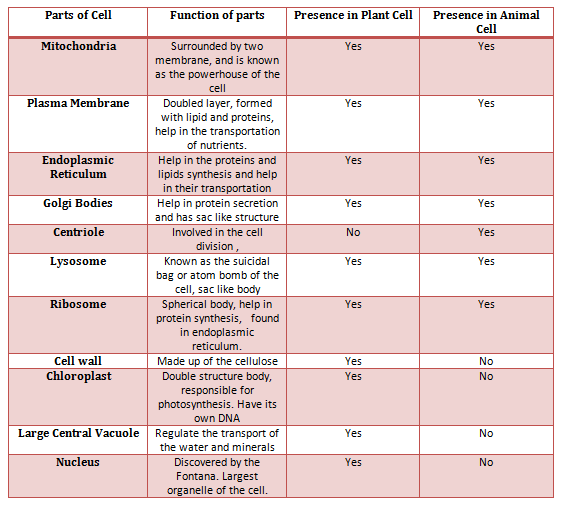
Cell: Cell is the structural and functional unit of all living organisms. The organisms which are made up of a single cell is called as the Unicellular  while the organisms made up of multiple cell like human being , cow and buffalo are called as the multi-cellular cell. Cell was discovered by the Robert Hooke, an English scientist in 1665.

All cells contain three basic structures:

  • Plasma membrane: It is made up of lipids and proteins and help in the transportation of nutrients form the external environment to inside the cell.
  • Cytoplasm: It is a fluid like substance that contains Cytosol and cell organelles such as mitochondria, chloroplast etc.
  • Nucleus : It is the main parts of the nucleus as it contains the genetic information as DNA present in it. Fluid inside the nucleus is Nucleoplasm.
*Protoplasm is the combined form of the Nucleoplasm and Cytoplasm.
*The Non-living things inside the cell are called as the Deutoplasm.

Cell Theory:

Cell theory is given by M Schleiden a German Botanist and T Schwann a British Zoologist. The main points of the cell theory are.
All living organisms are made up of the cells.
All cells arise from the pre-existing cell (Omnis cellula e cellula).
Virus does not follow the cell theory.

                                                      Detailed of Animal and Plant Cell

cell

Types of cells:

There are primarily two types of cells, i.e.prokaryotic and eukaryotic cells.

                                                   Difference between the two cells

cell 2

Chromosome:

chromosomes are the condensed form of the DNA. The cause of this condensation is special types of protein known as histones. When DNA is not condensed, it is called as chromatids. During cell division chromosomes show chromatids held together at a point called Centromere. End points of the chromosomes are known asTelomere. On the basis of position, centromere can be metacentric (present at the centre), sub metacentric (little away from the centre), acrocentric (situated close to the end), and telocentric (terminal centromere).

Types of Chromosomes:

Lampbrush Chromosomes: It was first discovered by the Balbiani , and it resemble the shape of the lamp brush.
Polytene Chromosomes: It was discovered by Balbiani  in salivary gland of  Chionomus larvae.

Genes:

Chromosomes also contains various genes. Gene acts as a unit  of inheritance in living organisms. It controls the transfer of genetic information from one generation to the next generation.

Atomic Models and Quantum Number.

Atomic Models:

To show the arrangement of fundamental particles in an atom various models were proposed, some important models are as follows:


Dalton's Atomic Theory:
The different assumptions of this theory are as follows;
  • All matters are made up of atoms which are indivisible and indestructible.
  • All the atoms of a given element have identical properties including identical mass.
  • Atoms combine in small whole numbers to form compound
  • Chemical reactions involve only combination, separation or rearrangement of atoms.
Thomson's Atomic Model:
  • Every atom consist of uniformly positively charge sphere having radius in the order of 10-10 m in which entire mass is uniformly distributed and negatively  charges electrons are embedded randomly.
  • Thomson uses the cathode ray tube to gives its atomic model.
  • This model is known as plum pudding model.
  • According to him negative charge particles are distributed in atom and to balance this negative charge some positive charge particles also present in it.
  • The atom as a whole is neutral.
Drawbacks of Thomson's Atomic Model:
  • It could not explain the origin ofspectral series of hydrogen and other atoms.
  • It could not explain large angle scattering of alpha particles.
Rutherford's Atomic Model:
  • He fired a beam of alpha particle on a sheet of gold to gives its model theory.
  • The existence of nucleus was proved by Rutherford in his alpha particle scattering experiment.
  • The entire positive charge and almost entire mass of atom is concentrated at its centre in a very tiny region of the order of 10-15m, called nucleus.
  • The negatively charged electrons revolve around the nucleus in different orbits.
  • Total positive charge on nucleus is equal to the total negative charge on electron; therefore atom as overall is neutral.
  • A nucleus consists of positively charged protons and electrically neutral neutrons.
Limitations of Rutherford's Atomic models:
  • According to Maxwell electromagnetic wave theory an accelerated charged particles emits its energy in the form of electromagnetic waves. Therefore an electron must emit emits energy during its course of accelerated motion around the nucleus. Due to which the radius of its path will decrease gradually and ultimately it will fall in the nucleus.
Plank's Quantum Theory:
Planck gave a new revolutionary theory of radiation known as quantum theory of radiation.
According to this theory
Radiant energy is not emitted or absorbed continuously but discontinuously in the form of small packets of energy known as photons (quanta).
The amount of energy associated with a quantum of radiation is proportional to the frequency of radiation.
Energy= hν
Where h is Planck's constant
Bohr's Model:
  • Bohr's model is based on the quantum physics i.e. quantization of energy
  • This model is similar to planetary model in which electron revolves around the nucleus in specific orbit
  • Bohr's model is considered as the primitive hydrogen atom model
  • Every orbit has a specific size and energy level.
  • Smallest energy is found in the smallest orbit as energy is related to the size of the orbit.
  • Electrons can move from one orbit to another by emitting or absorbing energies according to quantum mechanisms.
Heisenberg's Uncertainty Principle:
  • According to this theory the position and velocity or momentum cannot be measured at a single instant.
  • Heisenberg principle is not applicable to macroscopic objects
De-Broglie Concept:
  • De Broglie states that electron have dual nature i.e. wave nature and particle nature
  •  Wavelength (l) of an electron is inversely proportional to its momentum (p)
        l=h/p=h/mv, here h is Planck's constant
Shell:
The electron has a definite energy characteristic of the orbit in which it is moving. These orbit or energy levels or shells therefore also known as stationary orbits.
n=1,2,3,4
Shell =K,L,M,N
The shell with n=1 is closest to the nucleus and an electron in this level has the lowest energy as it is closest to the positive charge of the nucleus.
Distribution of electrons in different orbits:
  • It was suggested by Bohr and Burry and rules that govern it are as follows:
  • The maximum number of electrons present in a shell is given by the formula 2n2 where n=1,2,3 and 4 for K,L,M and N shells respectively.
  • The maximum number of electrons that can be accommodated in the outermost orbit is 8.
  • The shells are filled in a step-wise manner.
Electronic Configuration:
  • It is the arrangement of electrons in various shells, sub-shells and orbitals in an atom.
  • It is written as 2,8,8,18,32  
  • The maximum number of electron in a shell is given by 2n2
Filling or orbitals in Atoms:
The filling of electrons into orbitals of different atoms takes place according to the Aufbau Principle, Pauli Exclusion Principle and Hund's rule of maximum multiplicity.
According to Aufbau principle in the ground state of an atom, electron enters the orbital of lowest energy first and subsequent electrons enter in the order of increasing energies.
Lower the value of (n+l) for an orbital, lower is its energy.
here l is the azimuthal quantum number and n indicates the principle quantum number
If two orbitals which have same (n+l) value, the orbital with lower value of n has lower energy.
Hund's rule of maximum multiplicity deals with the filling of electrons into the orbitals belonging to the same sub-shell. According to this rule, electron pairing will not take place in orbital of same energy until each orbital is first singly filled with parallel spin.
Quantum Numbers:
Each electron in an atom is characterized by a set of definite values of three quantum numbers n, l and m. In addition of these three numbers, fourth quantum numbers is also needed which specifies the spin of the electron.
Principal quantum number (n):
Determines the main energy level of shell in which the electron is present.
 The various values of n are 1, 2, 3 and 4 etc. also known as K, L, M and N etc. respectively, as the value of n increases energy of electron also increases.
Azimuthal quantum number (l) determines the sub-level or sub-shell(s, p, d and f) in a given principal energy level or shell to which an electron belongs.
Magnetic quantum number (m) gives the information about the orientation of the orbitals.
Spin quantum number(s) describe the spin orientation of the electron; the electron can spin only in two ways, i.e. clockwise or anticlockwise.
Pauli Exclusion Principle:
It states that no two electrons in an atom can have the same set of four quantum numbers.


    Synthetic Material and Chemicals Used in Agriculture

    Synthetic Materials:

    Material created by man using the natural materials is known as the synthetic materials. Some important synthetic materials are given below:

    Cement:

    • Discovered by English Mason, Joseph Aspdin, he named it Portland cement.
    • Limestone, clay and gypsum are some important raw material that is required in the manufacturing of the cement.
    • When cement is mixed with water and left for some time, it becomes a hard mass. This is known as setting of Cement, it is an exothermic process that's why sprinkling of water is done for few days for a new construction.
    • Mortar is a mixture of cement, sand and water; it is used for plastering walls and binding bricks.
    • Concrete is a mixture of cement, sand, gravel and water. It is used for the construction of floors.
    • Structure having iron rods embedded in wet concrete is known as reinforced concrete.

    Glass:

    1. It is a super cooled liquid of silicate, it is amorphous in nature.
    2. Raw material used for the formation of glass is sodium carbonate, calcium carbonate and sand.
    3. Sudden cooling of molten glass make it brittle if cooled very slowly make it opaque.
    4. The process of slow and uniform cooling is called annealing.
    5. When glass is attacked by hydrofluoric acid, it is called etching of glass.
    6. Colored glass is obtained by adding certain metallic oxides or salts to the molten glass.
    coloured glass

    Types of glasses and their uses

    Soft glass (Soda Glass):
    • Mixture of sodium or calcium silicate.
    • Used in making of glass, mirrors and common glass ware etc.
    Hard Glass:
    • Mixture of potassium and calcium silicates.
    • Resistant to the action of acids and used for making hard glass.
    Pyrex glass ( Borosilicate glass) :
    • Used by fusing a mixture of sand, lime, borax and alkali carbonates.
    • Used in making of pharmaceuticals containers.
    Glass fiber:
    • Glass wool is an excellent heat insulator.
    • Used in insulating material in oven, refrigerator.

    Chemicals Used in Agriculture:

    Fertilizers:
    • These are the chemical substances which are rich in a particular nutrient.
    • They supply nitrogen phosphorus and potassium.
    • Excess used of fertilizers can reduce the fertility of soil.
    • Good fertilizers are easily dissolved in water and stable so that elements are retained for longer duration.
    • It should not disturb the pH level of the soil.
    • Urea is the best fertilisers.
    • Calcium super phosphate, nitro phosphate, triple phosphate and phosphatic slag(Thomas slag) are some important phosphatic fertilizers.
    • Mixture of nitrogenous, phosphatic and potash fertilisers in proper ration is called NPK fertilizers.
    • NP fertilizers are prepared by mixing nitrogenous and phosphatic fertilisers in a definite ratio.
    Pesticides:
    Pesticides are the chemicals which are used to kill pests which adversely affect the crops e.g. DDT and malathion .They can be categorized into the following category:
    • Insecticides
    • Fungicides
    • Nematicides
    • Molluscicides
    • Herbicides
    • Rodenticides: Zinc phosphide is used to kill rodents.

    Explosives

    • These are the substance which contains a great amount of stored energy that can produce an explosion.
    • Chemical explosives may consist of either a chemically pure compound such as nitroglycerine or a mixture of a fuel and an oxidizer.

    Types of Explosives:

    Primary Explosives:
    • A relatively small amount of energy is required for initiation.
    • Use in detonators e.g. acetone peroxide, silver azide and ammonium permanganate.
    Secondary Explosives:
    • Are less sensitive and require more energy for initiation.
    • RDX and TNT are some secondary explosives.
    Tertiary Explosives:
    • Used in large scale mining and construction operation and in terrorism.
    • Nitro-glycerine is a highly unstable and sensitive liquid also called Noble's Oil.
    • Dynamite is a mixture of highly sensitive nitro-glycerine with saw dust, powered silica.
    • RD X (Research and development explosive) is a very powerful explosive.

    Dyes:

    • Colored substances used for colouring wool, textiles materials and foodstuffs.
    • A material which is used as dyes must be able to fix itself to the material it is applied and must be resist the action of water, acids and alkalies.

    Dyes can be classified into the following category:

    Azo Dyes:
    • These dyes contain the azo group (-N=N-).
    • Formed during the coupling reactions, e.g. red, orange.
    Indigo id Dyes:
    • These dyes contains indigo id group in their molecules e.g. indigo.
    Anthraquinone dyes
    Phthalein Dyes

    On the basis of their applications dyes can be classified into the following types:

    Vat Dyes: these dyes are water insoluble dyes and applied to fibre cotton and are obtained from indigo dyes.
    Direct Dyes: these dyes can be applied to the fabric from their aqueous solution.
    Acid dyes: used as their sodium salts which are soluble in water.
    Basic dyes:In acidic medium these dyes are used to dye modified nylons and polyesters e.g. aniline yellow and malachite green.

      Gravitational Force and the period of Rotation of Satellite.

      Gravitation:

      Each and every massive body attracts each other by virtue of their masses. This phenomenon is called gravitation.

      Newton's law of Gravitation.
      The gravitational force of attraction between two bodies is directly proportional to the product of their masses and inversely proportional to the square of the distance between them.
      Gravitational force (F)=Gm1m2/ r 2
      • Where G is the gravitational constant its value is 6.67×10⁻¹¹ Nm2kg-2.
      • m1, m2 are the mass of two bodies and r is the distance between them.
      • Gravitational force is central as well as conservative force.
      Acceleration Due to Gravity of Earth:
      • The acceleration produced in a body due to the gravitational pull of earth is called acceleration due to gravity.
      g=GM/R where M is the mass of earth and R is the radius of earth.
      • The value of g changes slightly changes from place to place but its value near the earth's surface is9.8ms-2.
      • Gravitational force is the weakest ce in nature.
      Condition affecting the value of g:
      • Shape of Earth: Earth shape also affect the value of acceleration due to gravity that's why g is maximum at poles and minimum at the equator.
      • Rotation of Earth on its axis:
      • Effects of Altitude: The value of g decreases with the increase in height.
      • Effects of depth: The value of g decreases with depth and become zero at the centre earth.
      Mass and Weight:
      • The mass of a body is the quantity of matter contains in it and it is a scalar quantity and its SI unit is Kg.
      • Mass of a body does not change from place to place.
      • The weight of the body is the force with which it is attracted towards the centre of earth and it is given by w=mg.
      • Weight of the body is a vector quantity and its unit is Newton
      • The centre of gravity of a body is that point at which whole weight of the body appears to act.
      • Weight of the body is a variable quantity and it changes from place to place.
      Weight of a body in a lift:
      • When lift is at rest or in uniform motion then apparent weight is equal to the real weight of the body, w=mg.
      • When lift is accelerating upward then apparent weight is greater than the real weight of the body i.e. w=m(g+a)
      • When lift is accelerating downward then apparent weight of the body is less than the real weight of the body i.e. w=m(g-a).
      • When lift is falling freely under gravity the apparent weight of the body is zero i.e.
                W=m(g-g) as a =g
               w=0
      • Weight of the body on moon is lesser than the weight of the body on earth as the acceleration due to gravity at the moon is less than the acceleration due to gravity on earth.  Acceleration due to gravity on Earth is 6 times than that of on the moon.
      Planets:
      • Planets are the heavenly bodies which  revolves around the sun in a specific orbit or path.
      • Our solar system contains eight planets as Pluto losses its planet status.
      Kepler's Laws of Planetary Motion:
      Kepler gives three laws which are as follows:
      • All planets revolve around the sun in elliptical orbits with the sun at its one focus.
      • The areal speed of planet around the sun is constant.
      • The square of the time period of revolution of a planet around the sun is directly proportional to the cube of the semi-major axis of its elliptical orbit
      Satellite:
      • A heavenly body revolving around a planet in an orbit is called a satellite.
      • Moon is the natural satellite of the earth.
      There are two types of artificial satellites:
      Geostationary Satellite:
      • It revolves around the earth in equatorial orbits which is also called Geostationary or Geosynchronous orbit.
      • They revolve around the earth at the height of  36000 Km
      • There period of rotation is same as the earth's time period of rotation around its own axis i.e. 24 hours.
      • These satellites appear to be stationary.
      Polar Satellite:
      These satellites revolve around the earth in polar orbits at a height of around 800 km.
      The time period of rotation of these satellite is 84 minutes.
      Period of Revolution of a satellite:
      • Time taken by a satellite to complete one revolution in its orbit is called its period of revolution.
      • Period of revolution= Circumference of orbit/ orbital speed
      • Period of revolution of a satellite depends upon the height of satellite from the surface of earth, greater its height from earth surface more will be its period of revolution.
      •  Period of revolution is independent of its mass.
      Escape Velocity:
      • The minimum velocity with which when an object is thrown vertically upwards from the earth's surface just crosses the earth's gravitational field and never returns.
      • Escape velocity=(2gr)1/2
      • Its value on earth surface is 11.2 km/sec
      • When orbital speed is is increased by 41% i.e √2 times then it will escape from its orbit.
      Have a nice day


      Thursday, 12 January 2017

      Chemical Formula & Uses of Some Important Compounds.

      Here is the list of Compounds

      1. Compound Name: calcium carbonate
      Formula: CaCO3
      Uses: Non-prescription drug for relief from acid indigestion and heartburn. Also considered a calcium supplement..
      2. Compound Name: sodium chloride
      Formula: NaCl
      Uses: Used to season food (during food preparation and at the table), also used in the past as a method of food preservation.
      3. Compound Name: Methane
      Formula: CH4
      Uses: natural gas, fuel (also called Marsh Gas)
      4. Compound Name: Aspirin
      Formula: C9H8O4
      Uses: Pain Reliever
      5. Compound Name: Potassium tartrate
      Formula: K2C4H4O6
      Uses: cream of tartar, cooking
      6. Compound Name: Baking soda
      Formula: NaHCO3
      Uses: cooking
      7. Compound Name: Acetaminophen
      Formula: C8H9NO2
      Uses: Pain Reliever
      8. Compound Name: Acetic acid
      Formula: C2H4O2
      Uses: Active ingredient in vinegar
      9. Compound Name: Caffeine
      Formula: C8H10N4O2
      Uses: stimulant in coffee, tea, some soda
      10. Compound Name: Propane
      Formula: C3H8
      Uses: fuel for cooking
      11. Compound Name: Sodium carbonate
      Formula: Na2CO3
      Uses: washing soda
      12. Compound Name: Phosphoric acid
      Formula: H3PO4
      Uses: flavouring in soda
      13. Compound Name: Ascorbic acid
      Formula: C6H8O6
      Uses: Essential vitamin (vitamin C)
      14. Compound Name: Ammonia
      Formula: NH3
      Uses: fertilizer, household cleaner when dissolved in water
      15. Compound Name: Ethylene glycol
      Formula: C2H6O2
      Uses: antifreeze
      16. Compound Name: Calcium carbonate
      Formula: CaCO3
      Uses: antacid
      17. Compound Name: Ethanol
      Formula: C2H5OH
      Uses: disinfectant, alcoholic beverages
      18. Compound Name: Carbon dioxide
      Formula: CO2
      Uses: carbonating agent in soda
      19. Compound Name: Hydrochloric acid
      Formula: HCl
      Uses: production of batteries, photoflash bulbs and fireworks. It's even used to process sugar and make gelatin.
      20. Compound Name: calcium oxide
      Formula: CaO
      Uses: Less common in modern homes than in the past. Glows when heated; was used in theatres before invention of electric lighting. Health risks on skin contact or inhalation.
      21. Compound Name: Sucrose
      Formula: C12H22O11
      Uses: Used in cooking. Use as a sweetener.
      22. Compound Name: potassium carbonate
      Formula: K2CO3
      Uses: Potash is the common name for various mined and manufactured salts that contain potassium in water-soluble form.
      23. Compound Name: Plaster of Paris
      Formula: 2CaSO4·½H2O
      Uses: used for casts to hold broken limbs in place, modelling casts, sculptures and in plasterboard walls and ceilings
      24. Compound Name: Gypsum
      Formula: CaSO4.2H2O
      Uses: Use to manufacture dry wall, plaster, joint compound.
      25. Compound Name: sodium bicarbonate
      Formula: NaHCO3
      Uses: Used in baking where it reacts with other ingredients, releasing carbon dioxide (CO2), helping dough rise.
      26. Compound Name: sulphuric acid
      Formula: H2SO4
      Uses: Used in lead-acid batteries for cars and other vehicles. Formerly it was known as vitriol.
      27. Compound Name: hydrogen peroxide
      Formula: H2O2
      Uses: Used as a mouth wash (Personal Hygiene)